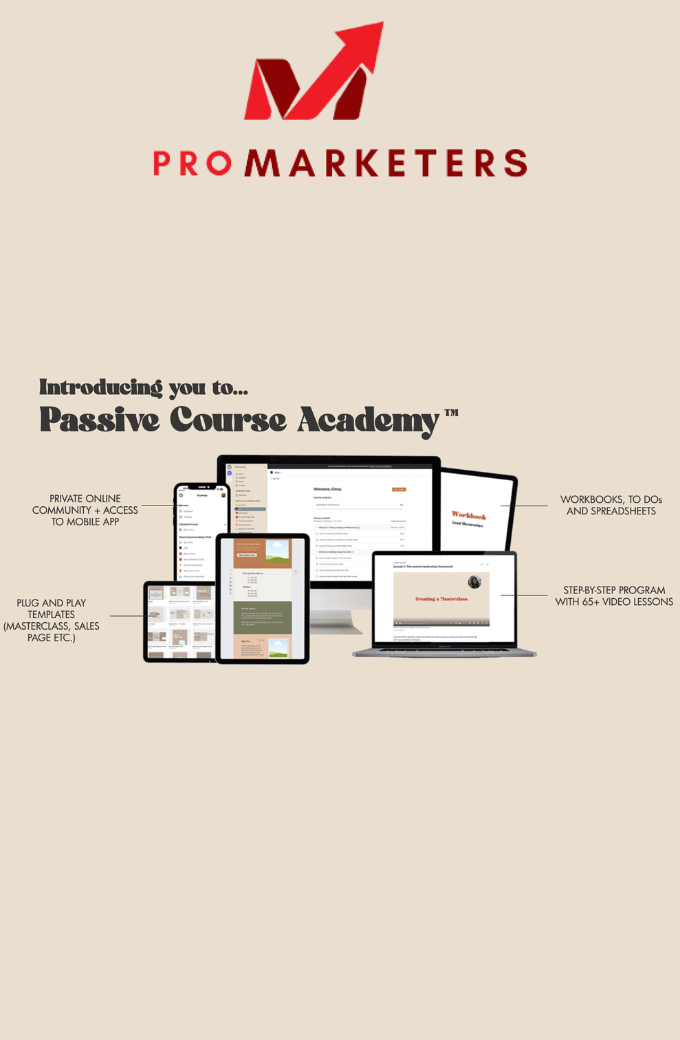
Description
Passive course academy is an online program that teaches creators how to plan, build, and sell evergreen digital courses. It starts with core steps like market fit, topic validation, outline design and lesson flow, and then ventures into funnel setup, email sequences and simple sales pages. To minimize guesswork, the Academy provides you with templates, checklists, and simple examples for outlines, price ranges, and pre-sale scripts. For traffic it relies on SEO, search-led content and simple ads with small test budgets. Support is provided via step-by-step modules and community Q&A. No niche lock-in, so content fits areas such as design, wellness, or software skills. Up next, the guide walks you through the process, tools, timelines and frequent roadblocks with fixes.
What is Passive Course Academy?
This online course for digital entrepreneurs focuses on building passive income through high-value courses and programs. The structure combines engaging course lessons, downloadable worksheets, and a comprehensive syllabus for every level. With immediate access via Teachable and Thrivecart, the course offers flexible, affordable payment options, providing a defined roadmap to launch, market, and expand lasting income.
1. The Philosophy
The core idea is simple: build a sustainable, scalable online business by turning proven expertise into online courses that sell while you sleep, with smart automation doing repeat work. It doesn’t promise no effort — it emphasizes early effort that results in consistent, passive income over the long term.
Mindset meets methodology. Students discover how to combine lucid offers and lean systems with authentic connection that retains students involved and minimizes churn. Community support is in the engine, not an add-on.
You take what you know. The course teaches you how to convert expertise in marketing, design, fitness, language, or coding into irresistible course downloads that others desire.
There’s some automation, but it’s applied judiciously. Email sequences, checkout flows, and delivery are automated, and live touchpoints–coaching calls, Q&A, feedback–build trust and raise retention.
2. The Audience
Designed for anyone and everyone looking to generate an additional passive stream of income from courses and digital products, from aspiring creators and digital entrepreneurs to service pros and professionals.
It catches beginners who need a clear launch and owners who want to branch out. A coach can supplement with a self-paced course. A designer can bundle a workshop series.
It fits the creatives, instructors, and tutors looking to start authority sites, niche products, or micro-courses. Subjects usually cover online biz, marketing and entrepreneurship.
It’s for anyone who desires reasonable rates, installment plans and a vibrant cohort. While most crave financial freedom or location independence, the course surrounds those objectives with concrete action.
3. The Promise
A step‑by‑step blueprint for idea validation, pre‑sell, launch, and ongoing sales, including funnel setup and analytics.
Continues updates, bonus content and tools like an ultimate bonus pack, a hooks vault that accelerates copy, pages and emails.
Practical advice on any audience research, offer math, pricing, and list growth. Think, for example, a webinar funnel, or a 7‑day email launch or an evergreen sequence.
Support features a private community, monthly coaching calls and expert feedback to eliminate obstacles quickly.
4. The Difference
A complete backend: payment integrations (Stripe, PayPal), checkout options, automated invoicing, and tax settings handled through platforms like Teachable and Thrivecart in one flow.
Targeted tripwire lesson and sales‑machine frameworks that build small victories—think a €7 checklist that powers a €199 course. Not standard in cookie cutter programs.
A high‑converting sales page lesson for today’s market, and a marketing machine playbook with email, affiliates and content hubs
Transparent refund policy and terms, instilling confidence in risk‑conscious students. Others experience slow slow courses with little revenue.
The Founders’ Journey
Ginny and Laura constructed Passive Course Academy after their careers in financial analysis, corporate marketing, and coaching. With 15 years of combined experience in business and marketing, they transitioned from the corporate world to creating high value courses and online course platforms. Their superpowers–strategy, course design, and marketing automation–work together seamlessly. The mission is simple: provide people with clear tools to build income, gain choice, and run lean digital businesses.
The Spark
The concept came to them when they witnessed increasing interest in passive income but terrible advice on the actual process. Most programs hawked nebulous promises or bypassed fundamental skills such as market validation, margin planning, and retention.
They mapped gaps: weak analytics, little support for evergreen funnels, and few examples that showed numbers. A lot of platforms inundated students with theory but overlooked pricing strategy, ad metrics, and fulfilment.
They mixed finance for unit economics, marketing for positioning and conversion, and digital product development for their modular courses. Initial validation came from a free hashtag guide lead magnet that cultivated a rapidly growing email list and social footprint.
The vision: a clear, affordable, global resource with step-by-step systems, templates, and case-based lessons that work whether someone sells a €49 mini course or a higher-ticket program.
The Doubts
They feared the space was too crowded, that the big names were getting all the attention. Market saturation talk was deafening, and trends moved quickly.
Pricing sparked debate: one-time vs. Payment plans, scholarships, and making sure students got value that beat cost. They emphasize mindset about money, frequently referencing Rich Dad Poor Dad and Cialdini’s Influence to connect psychology to business.
Upfront costs in ads and tools and production were real. We were pressed for time. Their initial offering, a membership, overextended them and seemed early—now referenced as a mistake they would avoid.
Automation sounded slick on paper, but would evergreen funnels stick? They experimented small, monitored data, and maintained hands-on check-ins prior to scaling.
The Breakthrough
Their initial course launch succeeded. Signups blew them away, and initial feedback from students validated the clarity of lessons and usefulness of templates.
Polished funnels and high converting ads optimized cpl then rpu Actionable frameworks, checklists and bonus packs boosted completion and referrals.
Community feedback directed updates, feature requests and new modules. Instagram growth—50k each in 12 months and 20k+ for the company in less than 6—validated market pull and honed their content machine. They now claim earning money online and achieving location freedom is easier to attain than people believe.
Deconstructing The Course
Designed for creators seeking consistent revenue from products or projects digital, the Passive Course Academy focuses on lucid, actionable steps and repeatable systems, offering irresistible course downloads. Content includes mini courses, masterclasses, and case studies – like ebook funnels, short video series, and lead magnets. Onboarding is simple: instant access, guided setup, and a tour of all modules.
Core Modules
The course curriculum is a total game changer, breaking down concepts to cash with specialized tracks such as idea validation and offer design. Mini courses and real-world case studies present various delivery options, ensuring the content remains easy to consume. With the use of an online course platform, users can access engaging course lessons through short videos, checklists, or swipe files.
Training includes strategies for high-ticket pricing and conversion tricks, focusing on offers that range from USD 1,000 to 3,000. The course also emphasizes the importance of community and group coaching, explaining how successful course launches can stack with evergreen automation and maintain quality through explicit community rules.
Advanced lessons delve into affiliate marketing strategies, upsells, and unique tripwire lessons, providing valuable insights. Additionally, there are tips on EU reporting and VAT for non-US creators navigating regional platform caps, making this an irresistible course for anyone looking to enhance their online sales.
|
Module |
Topics |
Outcomes |
Hours |
|---|---|---|---|
|
Idea Validation |
Problem-fit, audience signals, pre-sell surveys |
Validate demand, choose format |
3 |
|
Offer & Pricing |
Value map, bonuses, high-ticket tiers |
Build irresistible offer, set price |
4 |
|
Sales Page |
Hook, proof, objections, layout |
Write copy that converts |
5 |
|
Marketing Automation |
Email funnels, tagging, triggers |
Scale with systems, keep personal touch |
4 |
|
Affiliate & Upsells |
Payouts, tracking, bundles |
Increase AOV, partner reach |
3 |
Support System
-
Weekly group coaching calls and monthly audits
-
Private community with clear guidelines to protect member value
-
Mastermind pods, Slack channels, and a private forum for peer-checks
-
Priority helpdesk plus office hours with instructors
-
Bonus: Library of templates, checklists, tech walk-throughs, and favorite tools
Immediate instructor feedback is incorporated in the online course platform, providing time-stamped notes.
Actionable Frameworks
A launch blueprint walks through three phases: validate with fast surveys, prime with a short email series, then run a 7–10 day launch using webinars or live lessons. Including one case study with a 3‑week launch hitting USD 400,000 in sales.
Plug-and-play files like sales page blocks, email funnels and webinar promo packs. There’s a sales page system—a promise/proof/plan/price path, combined with skimmable copy and obvious FAQs.
A course framework matrix helps map content types to delivery: ebooks for deep dives, short video for demos, and lead magnets for list growth. Students record their own outlines for repurposing, mechanization and reach while maintaining personal feel with live calls and community nudges.
Beyond Scaled Content
Lean, high-impact lessons that build real change — not busywork. By utilizing an online course platform, we can maintain the course up-to-date, dynamic, and driven by real student data. The goal is consistent enrollment, more robust results, and additional time reclaimed for higher-leverage efforts.
Value Over Volume
Quality outperforms volume. Each lesson should produce a tangible output, such as crafting a course promise in a single sentence, outlining a step-by-step framework, or sketching a lead magnet. No more grandiloquent monologues that speak thinly. Take advantage of quick hit checklists, bite-sized demos and one sheet templates.
Trim fat by choosing a tiny selection of field-tested utilities. For example: one email service, one webinar tool, one survey app. A minimalist, rinse-and-repeat stack cuts noise and boosts build time. It simplifies updates when trends change.
Short, surgically targeted modules frequently prevail. A 12-minute video that walks you through pricing a high ticket course with a calculator and three sample tiers will resonate more than a 60 minute theory talk. Students complete quick, act, get to next phase.
Share outcomes, not hype: a tutor who replaced 1:1 hours with an evergreen cohort, or a designer who automated sales with a simple PDF lead magnet and a 5-email sequence. Transformation sells better than time, and it’s what students desire.
Evergreen Strategy
Use evergreen funnels to enroll year-round: ad or SEO traffic to a lead magnet, automated webinar, deadline-based offer, then a nurture sequence for those who aren’t ready. Keep copy centered on the transformation your course produces.
Automate onboarding with instant access, day-0 quick-start and 3/7/14 days timed nudges. This saves hours and increases completion and retention.
Lean on timeless tactics that survive platform changes: strong promise, clear proof, simple path, and soft deadlines. Update scripts and slides as markets shift.
Teach students to build durable assets: a lead magnet that answers one burning question, a 30–40 minute automated webinar, and a metrics dashboard tracking opt-ins, show-up rate, and sales. Against what, then, do you measure progress?
Student Feedback Loop
Conduct quick surveys following major milestones, leverage polls within the community, and include a one-click ‘Was this helpful?’ at the close of every lesson. Completion forms can inquire what impeded progress and what succeeded.
Check your data on a monthly basis. If lots stall at Module 2, add a worksheet or a quiz or shrink the video. If price pushback increases, try new tiers or bonuses. If support tickets spike, log a 5-minute fix.
Peer reviews and testimonials add credibility. Promote wins posts, before & after snapshots, and quick screen-grabs of outcomes. Community of peers and mentors helps with questions, morale, momentum.
Let feedback be your guide in planning updates, new modules, and bonus packs. Maintain the core evergreen, overlay the updates, keep the high-ticket stuff for deep support and passive income. Design and automation of digital products liberate time for strategy and life.
The Business Toolkit
Designed to get you up and running a successful course business with less guesswork, this toolkit blends training, tech guidance, and support. It features a six-module step-by-step system and an extensive 10-module library with online course lessons, bi-weekly group strategy calls, and a Facebook Community. The pricing plans range from $149 to $399 a month, with the Growth Plan available at $199 per month, offering a 20% discount when billed annually. Video walkthroughs cover the core platforms for email, payments, funnels, and automation.
Essential Platforms
-
Stripe, PayPal, Wise
-
Stripe: strong global reach, supports cards and wallets, solid fraud tools, fast payouts in many countries. Fits one-off, payment plan, subscription and trial.
-
PayPal: wide trust, helpful for buyers without cards, fast checkout, holds may occur and fees can be higher in some markets.
-
Wise: low-cost multi-currency accounts and payouts, useful for paying affiliates and contractors in EUR/GBP/AUD, then settling in USD.
-
Global checkout options
-
Deploy Stripe Checkout or Paddle to manage tax and 3D secure. Include Apple Pay/Google Pay. Provide local options (iDEAL, SEPA, PIX) when available. Display prices in local currency. On a similar note, offer split-pay and installment plans.
-
Email, funnels, membership
-
Email: ConvertKit for creators, ActiveCampaign for advanced automation, MailerLite for budget. Use tags for lead magnets and behavior based sequences and win back flows.
-
Funnels: ThriveCart or CheckoutJoy for cart + bump/upsell, or Kajabi/Kartra for all-in-one. Add automated post-purchase onboarding.
-
Membership: Circle or Skool for community; Kajabi for baked-in courses; wordpress + memberpress for control
-
Comparison
Platform | Primary use | Starting price (€/mo) | Advantages | Disadvantages Kajabi | All-in-one | €119 | Unified stack, native pipelines | More expensive, less flexible ThriveCart | Cart + affiliates | one-time | Fast checkout, bumps/upsells | Limited email ConvertKit | Email + funnels | €15 | Creator-friendly, tagging | Less CRM Circle | Community | €39 | Clean UX, spaces/events | no native email Wise | Payouts | pay-as-you-go | Low FX fees | Not a checkout
Traffic Strategies
-
Have one obvious CTA above the fold. Zip images, load < 2 seconds. 1 pledge, 3 proof points, easy form.
Take YouTube ‘how to’ videos, each with a lead magnet link. Post blog posts that answer questions and link to the same opt-in. Provide a brief checklist PDF and 10-minute setup video.
Conduct a 45-minute webinar featuring live chat Q&A, offering a 24-hour replay and an incentive for quick purchasers. Incentivize affiliates with 30–40% commission, a pre-built promo kit and Wise payouts.
-
Include testimonials close to the CTA. Try exit-intent popups with a softer offer. Headline test weekly.
Revenue Models
-
Pricing ladder
-
Low-ticket (€9–€49): mini course or template pack; drive volume and qualify leads.
-
Core (€99–€399): full course with community. Growth Plan $199/mo goes here.
-
High-ticket (€1,000+): cohort or 1:1 add-on, limited seats, clear outcomes.
Memberships at $149–$399/month with monthly workshops, templates and the Facebook Community. Add yearly + 20% discount. Think mastermind levels with small-group calls.
Track MRR, churn, LTV, and refund rate in a simple sheet + Stripe analytics. Automate dunning, receipts, VAT/GST, and affiliate payouts with Stripe + Quaderno + Wise Leverage cart bumps (checklist), 1 click upsells (templates) down-sells (extended plan)
Real Student Transformations
What happens when people implement Passive Course Academy is evident in the statistics and the personal victories. With real student transformations, students experience consistent increases in income, ability, and confidence supported by elegant systems they can operate anywhere. The program offers a 14-day free trial, bi-weekly group strategy calls, and a Facebook community that helps students test ideas, patch holes, and stay on track, making it a compelling online course platform.
One ex-teacher utilized the unique course framework to wrap a mini course and dangled it with a brief email funnel. Her first full launch made $25,000 in one month, which was as much as six months of her previous salary. Previously, she depended on bespoke lesson plans and hourly labor. Then, she sold a pre-recorded online course with a definitive promise, a clean landing page, and bonuses at timed intervals. Now, she utilizes a repeat launch schedule and upsells a coaching add-on, providing her with predictable income and time to develop new content.
One other student serviced clients rather than a full course. Tightening her niche, rewriting her offer page, and attaching a short discovery form, she signed three new clients in a few weeks. She established a lead magnet connected to a 5-email welcome series. That shift by itself reduced her lead time and increased close rate with no paid advertising.
One graduate mixed it up and dedicated themselves to an evergreen funnel. Over the next three years, that one system generated over $2 million in sales. The stack was lean: one lead magnet, one webinar, one sales page, and one core product. Traffic, however, came from weekly content and fundamental search tuning. Maintenance was light—quarterly page updates, new case studies, and a simple retarget ad.
Mini-offers work. One member constructed a mini-course that drives nearly $10,000 per month. It cracks one specific issue, operates on an impulse video and nurtures a premium program. She follows important stats—opt-in rate, cost per lead, and sales page conversion—to do small, continual tweaking.
Across the board, students cite two significant shifts: more income and enhanced confidence. More individuals hit milestones quicker once they employ the templates, checklists, and feedback loops. One launch had 70+ entrepreneurs sign up within 24 hours of opening a waitlist—proving the demand when the message is razor-sharp and the offer is obvious, showcasing the power of a successful course.
Conclusion
To summarize, Passive Course Academy provides a nice roadmap. The promise is simple: build a lean course, sell it with proof, and grow with smart systems. It all feels doable. Quick vids. Nice templates. Simple steps. No fluff.
The narrative follows the successes we observed. A diet coach sold her initial 50 seats in just two weeks. A math tutor hit €8,000 in month 1 with 1 webinar. A UX lead pre-sold 120 seats with 1 page + 2 emails. The tools back the plan: offer map, launch calendar, sales page blocks, and clear data checks.
Ready to try it on for your work? Go small. Choose a subject. Write the offer. Post it to an actual community. Then adjust and adjust.
![[ONLY $10] Brian Rose - Business Accelerator](https://mla4a5mncqxd.i.optimole.com/w:600/h:918/q:mauto/f:best/https://promarketers.cc/wp-content/uploads/2023/06/London-Real-Business-Accelerator.png)