

Description
Day 1
Day 2
Day 3
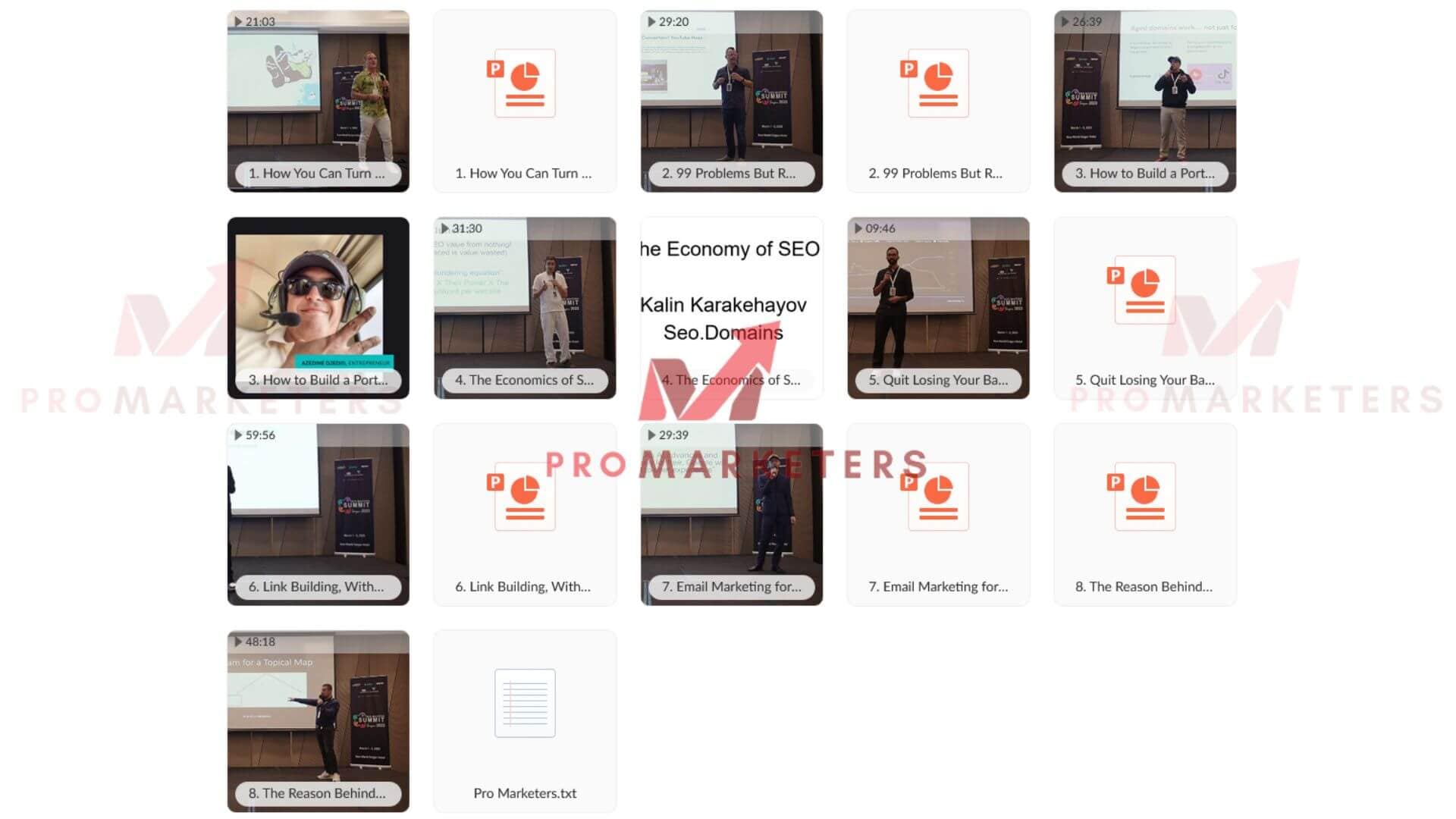
Expert sessions from the world’s leading SEO event, held in Ho Chi Minh City. We take you through practical strategies, case studies and tools. They include sessions on keyword research at scale, technical audits for giant sites, content frameworks, digital PR, and link risk checks. Sessions feature step-by-step setups for log file analysis, site speed fixes, internal link maps, and schema rollouts. Speakers share templates, dashboards and real campaign data for teams and solo pros. To assist in selecting what to watch first, the guide below maps sessions to skill levels, goals, and use cases — with brief annotations on video length, key takeaways, and tools employed — so time is directed toward the sessions with the greatest value.
The Saigon Blueprint
A practical playbook inspired by our SEO Mastery Summit Saigon recordings, the Saigon Blueprint provides clear steps, validated concepts, and reproducible strategies for teams seeking sustainable search-driven growth. This actionable SEO course offers insights into effective SEO tactics that can transform your SEO efforts into measurable outcomes.
What sets these recordings apart is that they package together battle-tested strategies with actual experiments and case observations, not just theory. You receive 18 traffic and income enhancing replays that address on-page adjustments, off-page systems and AI usage in research and content. It comes with a library of 160+ SEO tests – new ones are added each quarter. That depth allows you to contrast what works across niches and site sizes. One user example: a content site applied the internal link and entity mapping workflows and saw a 30% lift in organic visits in 60 days, measured in Google Search Console. It only costs a one-time $97 for lifetime access, with a 14-day money back guarantee.
The blueprint breaks SEO into scalable frameworks that you can roll out across a single site or an entire portfolio. For on-page, it shows a simple order: map search intent, design a lean outline, add entities, set canonical and schema, then measure click-through changes after title tests. For off-page, it uses a risk-aware approach: focus on link relevance and link velocity caps, diversify anchors, and track link-based changes at the URL level. For AI, it sets guardrails: use AI for draft briefs and clustering, keep human review for facts and tone, and run a small test set before scaling. These systems translate into growth: more qualified clicks, higher revenue per session, and stronger moats in tough SERPs.
Edge is learning from its acknowledged masters. The Saigon sessions feature renowned SEO experts and operators who demonstrate entire processes, not just slides. Think live teardown of topical maps and sandbox-safe link velocity tests and programmatic SEO workflows with crawl budget checks and post-update recovery paths powered by log files and server data, not guesswork. You see why steps are important and where they fall apart.
The community bridges the gaps between lessons. You gain entry to an exclusive SEO group and a weekly coaching call for feedback on audits, content strategies, and link outreach. This creates a worldwide community exchanging experiments, templates, and arranging co-publishing or digital PR swaps that accelerate everyone’s effectiveness in the SEO field.
Unlocking SEO Mastery
Mastery rests on clear principles: align pages to search intent, ship consistent content with integrity, fix technical debt early, and measure what matters. The renowned SEO Mastery Summit recordings demonstrate on-page, off-page, and AI-based methods in concert, supported by actionable insights from SEO experts, seasonal updates, and peer-reviewed standards. Ongoing learning is a given, as effective SEO tactics and rapid adaptation frequently determine victors.
1. Strategic Frameworks
Top speakers at the renowned SEO Mastery Summit map campaigns in five steps: diagnose (crawl, logs, SERP features), model demand (cluster keywords by jobs-to-be-done, seasonality, and intent), build assets (topic hubs, programmatic pages, digital PR hooks), ship and interlink, then review against benchmarks every 30 days. International firms stress scalable SEO playbooks: a content engine that pairs expert briefs with AI drafts and human edits, a technical backlog ranked by impact, and link acquisition via data stories and partner outreach.
Structure at scale with frameworks: keyword trees by intent tiers, content sprints that ship 10–20 briefs per week, and technical OKRs tied to crawl budget. For a marketplace, programmatic templates, for SaaS comparison and use-case pages, for ecommerce facets, canonical logic and merchant data. Build a little table to contrast these paths by team size, speed and risk.
Incorporate some competitive gaps and search trend data. Monitor trending queries, SERP layout changes, and fresh query mixes to inform backlog prioritization, ensuring effective SEO strategies are applied throughout the process.
2. Content Integrity
Value and uniqueness triumph sustainable ranks. Speakers demonstrate how expert-led drafts, original data and transparent sourcing fuel trust and links.
Intentionally utilize briefs, entities, FAQs, and metrics, incorporate first-party stats, screenshots, and step flows, follow style guides, and release updates on a fixed schedule.
Integrity establishes leadership, reduces CAC and escalates revenue. Leverage summit case studies and test results to prune thin pages, combine overlap and boost E‑E‑A‑T signals across author bios and citations.
3. Technical Precision
Actionable tactics: speed under 2.5 s LCP, clean CWV, stable CLS, accurate canonical and hreflang, XML and HTML sitemaps, log-file checks for crawl traps, smart internal links and paginate with next/prev patterns replaced by clear linking.
Quarterly, conduct audits with tools demonstrated at the summit, keep an eye on monthly log samples and indexation by template.
Set programmatic workflows: schema at scale, template-level copy blocks, and automated internal links. For large ecommerce and niche sites, precision safeguards crawl budget and unleashes long-tail growth.
4. Performance Metrics
Monitor organic sessions, indexed pages, share of voice, 100 top coverage, CTR, conversions and revenue YoY. + page health + link velocity
Create a dashboard or basic table mapping KPIs to goals and industry baselines shared in sessions. Leverage data to rebalance funnels, repair drop-offs, and test titles, internal links and modules. Demonstrate ROI through quick wins and compounding growth.
5. Future-Proofing
Utilize machine assistance for outlines, entity verification, and question-answering, while ensuring human judgment remains paramount. Stay updated with algo changes and test their impact on staging, making swift tweaks as needed. Maintain a living test database with quarterly updates and peer reviews. Invest in an actionable seo course for lifelong access to training, fostering a community for Q&A and shared learning among your seo team.
Beyond Theoretical Knowledge
Here’s where the Saigon recordings come in if you’re interested in actionable insights — not just ideas.
Practical, actionable courses with real-world use
The sessions at the renowned SEO Mastery Summit really dig into how to plan, ship, and measure effective SEO work. Speakers break down tasks into steps: keyword mapping by search intent, content briefs that match query types, internal link hubs, and technical checklists that cut crawl waste. You watch complete demos of on-page rewrites, indexation fixes, and link outreach workflows. For instance, a content pruning session demonstrates how to tag pages by traffic, links, and intent, then establish rules for merge, update, or delete. Another demonstrates an easy way to boost Core Web Vitals with lazy load and image compression — measured in seconds and kilobytes, not ambiguous victories. The point is clear: know the why, then do the how. It emphasizes commercial applications. Beyond the theory of knowing how SEO converts, turning those skills into an actual service or affiliate site requires pricing, scoping, and reporting. You receive templates for proposals, briefs, and monthly decks that connect work to leads and revenue, enhancing your overall experience in the SEO community.
Results through cases and audits
The sessions at the renowned seo mastery summit are full of case studies with actual numbers and context. Many visitors record leaps such as 2,200 to 14,000 monthly visits after implementing gap analysis, content consolidation, and internal linking from the actionable seo course lessons. You get to see long-run practice. One track walks through lessons from 150+ audits: recurring crawl traps, thin category pages, missing topical clusters, and cannibal posts. The takeaway: clear strategy plus tight execution wins. You have to understand which lever to pull, why it’s stuck, and how to test the change in Search Console and analytics.
Hands-on training to speed careers and agencies
Apply the playbooks as sprints to enhance your SEO efforts. Week 1: conduct a site audit and implement quick technical fixes. Week 2: develop a keyword map and brief a cluster of five pages. Week 3: publish, interlink, and request two relevant links per page. Week 4: log changes, annotate data, and review wins and misses. Repeat this process every month. If you run client SEO campaigns, add a simple scope: one audit, one roadmap, two content packages, one link block, and one report. If you create affiliate sites, choose a niche, run the same sprint, and measure income per 1,000 visits. Others may prefer a one-time investment in the SEO mastery summit course instead of a monthly fee, which can be cost-effective if you pursue a 90-day build plan and complete major tracks start to finish.
Community, tests, and ongoing support
SEO can feel solo, but gains grow with shared proof within the SEO community. A committed group compares notes, swaps outreach scripts, and provides feedback on audits. Many pros claim that consistent access to expert insights and in-depth analysis from the SEO mastery summit built genuine confidence in their service pitch. A searchable database of SEO tests—title tag trials, internal link patterns, and schema tweaks—simplifies figuring out what to try next. Take victories in customer SEO or associate initiatives, submit outcomes, then define. Specific insight plus repeatable action is what shifts the needle globally, regardless of site size or market.
The Content Quality Imperative
Content quality determines who conquers search and who remains trapped. The renowned SEO Mastery Summit recordings repeated a simple truth: high-quality content is essential for SEO success, and it is a critical ranking factor. Quality is not an abstract aspiration; it includes query relevance, factual accuracy, and genuine engagement that holds users on the page and inspires action. Achieving this requires time, effort, and budget. Most scribes can’t clear that bar on the initial attempt, so SEO teams should anticipate serious cutting or a rewrite loop. A content audit is the first step in an effective SEO campaign. It reveals what works, what’s thin, and what should be consolidated or retired, allowing you to invest where the gains are most probable.
By knowing the psychology of search engines and people, you can make your content rise above the noise. Search engines attempt to model user happiness. Users desire evidence and a next step. Pages that solve a task well rank and convert. From the top, the recommendation was to combine audience research with intent mapping. If someone searches “buy noise-cancelling headphones 200–300 EUR,” create a page with obvious choices in that range, specs in metric units, price filters and brief sound tests. If they search ‘how to choose,’ guide with easy steps, a decision tree, and examples. Match format and depth to intent, not a word count.
The strategist playbook from the recordings with tight loops. Begin with a quarterly content audit. Rate each URL for traffic, conversions, links, freshness, and topical fit. Sunset dead pages or 301 them into beefier ones. For new pieces, run a brief before a draft: goal, primary and secondary intents, main questions to answer, E-E-A-T signals (first-hand details, sources, author bio), and a list of competitors to beat on clarity and coverage. Write in your own words, include original statistics or light visualizations, and link to research. Fine tune after you write. Patch page titles to reflect the central question and advantage. Write meta descriptions that establish expectations. Use short H2s that reflect the questions users ask. Add schema where it helps (FAQ, product, how-to). We compress images, add alt text and keep our page speed tight. Track outcomes past rankings: measure dwell time, scroll depth, and conversions, then refine. Top-notch material is not a once-off. It is a persistent learn and ship loop.
Navigating Future SEO Trends
The Saigon recordings stressed a simple truth: SEO never stands still. New trends, new rules, and new user habits are forcing teams to rethink how they plan, build, and measure search engine optimization. The emphasis is shifting from fast exploits towards learning systems that deliver effective SEO strategies.
Speakers unpacked programmatic SEO as a key lever for scale. Teams construct data bases, map templates to search intent, and deploy thousands of pages w/ rigorous QC. It’s good for product variants and locations and FAQs, only if every page adds unique value and has clean internal links. Advanced keyword research goes beyond volume and difficulty. They then layered SERP features, user tasks, and entity gaps to identify those queries where helpful content and structured data can win. That’s especially important as AI and machine learning re-architect how engines rank, cluster and display results — frequently mixing answers, products and media on one page.
New markets aren’t just about translation. It requires language variations, cultural signals and local search engines where Google is not the default. Teams localize content according to local holidays, payment habits and units (metric) and configure separate tracking for each location to observe user behavior. Voice search and chat-driven queries increased in the sessions, with an effort to target long tail, natural language, and follow-up intent. Structured data is table stakes now. Schema powers engines to parse context, surface rich results, and power AI summaries, but it must align with the on-page claim and be kept up-to-date.
User experience remains a critical driver for ranking and revenue. Factors like page speed, mobile-first design, and accessibility are guiding layouts, media size, and code. Speakers noted improvements from image compression, lean JavaScript, and transparent navigation patterns. The content strategy favored depth and clarity over sheer scale, advocating for the creation of topic hubs, sourcing citations, and maintaining page freshness. The overarching message was holistic: connect SEO with social signals, email, PR, and analytics to understand how demand forms and flows.
-
Programmatic SEO with strict quality and de-duplication
-
Entity-first keyword research tied to SERP features
-
Schema markup for products, reviews, how-to, and FAQ
-
Voice search: target conversational, multi-turn queries
-
UX: speed budgets, mobile patterns, accessibility checks
-
Geo-expansion: hreflang, local links, and market research
-
Analytics: event-based, privacy-ready, and cross-channel ROAS
-
Continuous learning via global conferences and working groups
Applying Lessons to Niches
Don’t take the Saigon recordings as a script; instead, view them as a toolkit for effective SEO strategies. Start by mapping each talk’s principle to your niche’s user intent, compliance limits, and monetization model. Construct niche personas, identify pain points, and record query habits by stage (awareness, compare, convert). Then tailor templates and frameworks from the renowned SEO Mastery Summit to your limitations, pilot on a minor slice, and amplify what works.
For affiliate marketing SEO, marry commercial intent with content depth. If a session is on topical maps, reduce the cluster to high-intent leaf pages with explicit comparison reasoning. Take your SERP feature cues–PAAs, price snippets, FAQs–to inform outline and schema. For the speakers, display internal link hubs, reflecting them with bottom-up links from reviews to best-of hubs, to brand primers. Here’s an antibiotic: I’ve applied the lessons to niches from the SEO Mastery Summit course.
Casino affiliate sites require tougher compliance and risk control. Local laws differ, so combine global keyword structures with geo fences, age cautions and responsible-gaming components. Plug location modifiers into templates (e.g, “best welcome bonus in [city]”) and apply exact schema for offers and terms. Only localize what converts, and keep language QA close to legal review. Monitor page health with log files to monitor crawl behavior on frequently changing bonus pages.
Small affiliate sites succeed through specialization and agility. Choose one micro-topic, ship a lean content set using the summit’s outlines, and keep a simple link graph: topic hub, three comparison pages, five in-depth reviews. Leverage lightweight tech–static pages, image compression, minimal JS. Gather first party data with short polls and use it to tune FAQs and pros/cons areas.
-
Affiliate SEO: commercial-intent clusters vs. 1 comparison templates pros/cons lists product schema intra-review to hub links ‘X vs Y’ pages.
-
Gambling affiliate: geo-modified intent; bonus-change workflows; offer schema; E-E-A-T bios with license IDs; responsible-gaming FAQs; local SERP watch.
-
Small sites: micro-topic sprints; one hub + 8–10 spokes. manual outreach to 20 similar sites; speed budgets; simple faceted nav shunned.
-
Templates: topical map builders; entity checklists; outline blocks; link hub blueprints; on-page QA lists; change logs.
-
Content ideas: lifecycle guides, price monitors, data-driven comparisons, regional rule explainers, seasonal update posts.
Apply lessons to niches. Use regional expert to localize SERP reading, backlink standards, and policy notices. Use their case studies to tailor outreach pitch, anchor diversity, and publishing cadence by markets.
This approach will not only enhance your online visibility but also ensure you gain a competitive edge in the SEO field. By leveraging insights from the SEO community and implementing actionable SEO tactics, you can drive better business profitability and organic search traffic.
Conclusion
To tie it all up, the Saigon talks contain clear steps, not fluff. The playbook stays tight: test fast, ship clean content, fix crawl gaps, track with real KPIs, and keep pages light. The wins look real: sharper title tags, lean code, clear link hubs, and tight topic maps. Consider a health blog that cuts short skinny posts, peppers in data charts and records a 20% increase in click rate. Or a local store that repairs GSC faults and ranks in the top 3 for “shoe repair near me.
To stay on pace, pace yourself at one test per week, one content fix per day, and one site sweep per month. Want the entire Saigon recordings & notes? Get the bundle and begin your initial experiment now.


